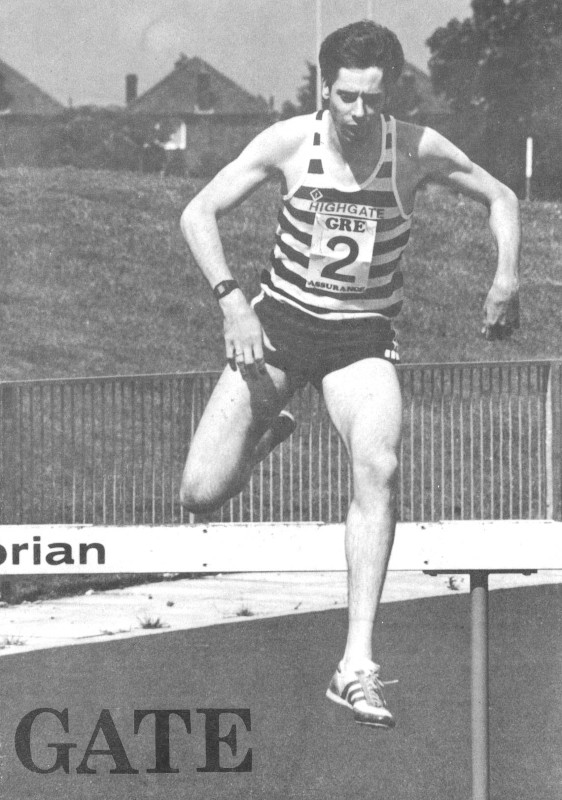

Cover Picture by Ron Webb
shows Dave Burrows
Page 2
SEPTEMBER 1989
Editors
Bob SloweRob Kennan
Congratulations to Alex Fugallo on being selected to run in the European Junior Championships.

The Resources Committee discussed the question of prize money won by club relay teams. In the past some of the money has gone to the athletes and some to the club. This procedure was formally approved by the committee but the actual amounts will depend on the circumstances in each case.
The Fun Run was as ever a success, despite the prophets of doom before the event. Charles Allan and his team overcame most of the problems as they arose and sidestepped the rest so that everyone who came had a good time. Bill Moles- worth, no doubt mistaking the event for the first Metropolitan League match, came storming home to win, which is not quite what the club intended. Never mind, perhaps he will act as hare next year. Thanks to all those who rallied round to help.
If you are interested in the future of the club please be sure to attend the AGM. You will receive a notice in due course. It is generally in early December
Alan Corfield read the Resources Committee a letter he had received from a member who had sent a donation and said how much he enjoyed the Gate. Unfortunately Alan had used a highlighting pen and this had totally dissolved the Signature so we never found out who sent it! (We subsequently found that it was F.Duff)
The club is still looking for a sponsor. Charles Allan has approached many firms but so far none has actually decided to come up with the money. Charles is still trying and we hear that Peter Ellingham is also working on the problem. However, if any of you have a contact through work or in any other way please let us know as the need is becoming ever more urgent.
Page 3
SHORT OF A WHITEWASH
By Joe Phelan
The season opened with the club in a
new division and with a larger team than
the previous year. Rob said anything
short of a whitewash would be a disappointment. The first three league
matches went according to plan with
three straight wins, notably the third
when an almost complete team scored
236 points in the process of beating the
opposition, our best result of the season.
The fourth match at Parliament Hill saw
a confrontation between the three only
unbeaten teams in the league; Camberley, Highgate and Ipswich. Highgate’s
strongest team of the season was fielded,
chiefly at the expense of Rob’s phone
bill; 82 slots out of the 87 were filled and
the battle was on.
Up until then the Boys throws had
been left chiefly to Andre Mishra and
Damian Smart but Mono Hussain and
Waldo Barker were there to back them
up, getting us off to a good start with a
first and second in the hammer (26.26
and 15.84) and scoring valuable points in
the shot and discus. Sam Raby and Des Shelley did equally well...
...in the 400
hurdles, the first track event, with a
second and a first and these results,
coupled with a double win for Bree
Coutts and Jago Brown in the high jump
as well as a personal best (11.55) and
first place for Damian Smart in the triple
jump put Highgate in the lead.
This early success was continued with
a double first in the Youths hammer for
Charlie Cross and Joe Phelan. (Charlie’s
best of the season, 49.24, was achieved in
winning the London Schools and is a
new club record).
These events were followed by the 200
and 400, events in which both we and
Camberley were strong. Paul May and
Kavan Beklik worked hard for two
seconds in the Colts 200 and Ben
Caplan, Jon Levy, Peter McGovern and
Lyndon Hammond picked up valuable
points in the Boys and Youths events.
Peter and Sam Philips secured a double
win in the Boys’ 400 (Peter holds the
club record in this event with 54.8) Ben
Caplin finished a strong second in the
Youth's 400 with 54.5 and we were still in the lead, just.
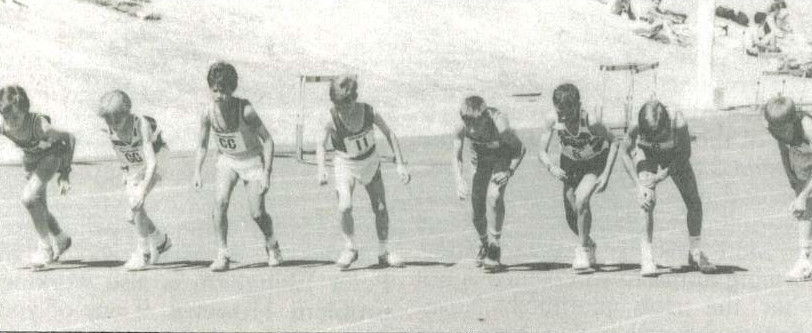
The start of the 800m with Matthew Ellingham and James Morton
Page 4
Short of a Whitewash continued...
Meanwhile on the field Damian and Andre recorded a first and a third in the Boys javelin, and Alton Scott (11.31) and Charlie (11.26) took second and first in the Youths shot. We were still in contention. In the long jump Michael Jarrett and Paul Scott-Godfrey earned two seconds for the Youths, and Lyndon and Andre a second and a third for the Boys. Bree Coutts sealed an easy win in the Pole vault, coming close to his own club record...
After disappointing results in the short sprints and discus we were about 12 points adrift with just the relays to go.
Dominic Velden, Paul, Kavan and Matthew in the Colts 4 x 100 ran well with smooth changeovers to win but disaster! - the Boys were disqualified and the Youths came nowhere. Sam Philips, Lyndon, Damian and Peter won the Boys 4 x 400 in a new club record of 3:56.6 to close the gap a bit but despite a good effort by the Youths 4 x 400 team we still finished well behind Ipswich.
Final Score Ipswich 236, HIGHGATE 210, Camberley 181.
In the final match a reduced team still managed second place which was enough to get us to the promotion match on 10th September at Bracknell.
THE WHITEWASH
The 4 x 400 Boys team lowered their club record by a remarkable six seconds to 3:50.6 and Peter McGovern recorded 54.0 in the individual 400 to improve on his own figures. Peter deservedly won the "man of the match" award - something...
Never mind; as the man said “it is better travel hopefully than to arrive" and we certainly spent the season travelling hopefully. As long as we enjoy it it really doesn’t matter what division we are in - as long as it’s Division 1 in 1991.
It’s on with the spikes and ready for another cross-country season.
R.E.K.
Page 5
SCIENCE
In our May 1987 issue we published an article entitled “A Spring In Your Step” which summarised a piece from New Scientist. The article dealt with the question of energy return and concluded that shoe manufacturers may have to turn their attention from designing shoes which absorbed shock to a system that actually returned energy like a spring to increase performance. An experiment at Harvard had shown that it was possible to “tune” an indoor track by making it slightly elastic, thus improving performance by 3%; could not this technique perhaps be applied not to the surface one runs on but to the shoe itself?
New Scientist (15.7.89) has returned to the subject to see if the question has been answered. Its verdict; “the jury is still out”.
The main protagonists of energy return are Reebok with Converse, Hi-Tec, Saucony and Turntec also in the field. Nike are very critical of the concept of energy return and argue that softer more compliant materials should be used for better cushioning. Avia take a similar position and argue that in any event “a truly functional energy return system would have to capture the energy from heel strike beneath the rearfoot and transfer it to the forefoot to effectively return any of the energy to the athlete. To date, no such system exists in athletic footwear”. Avia’s consultant, Peter Cavanagh of Penn State University says “Supposing for a moment that true energy return to the body can be achieved, then it is certainly likely to lead to faster times and this will be important to runners at an elite level.... But for most runners the goal is usually to expend energy - thus most runners are concerned with maximising energy expenditure rather than minimising it” (Nb. This view would probably not be shared by the majority of club members).
Cavanagh also cautions against simplistic conclusions: “A steel bell on a concrete surface would give an excellent score for energy return but no one would suggest that a shoe made from those materials would be acceptable.”
Some manufacturers, eg Asics, New Balance, Adidas, Brooks, have not yet entered into the debate on energy return.
The article concludes that “Many runners are sceptical about the new developments and often they are displeased that old favourites have been replaced by super-duper new models with different names. At the end of the day, what runners really want is injury-free running, and lots of it, whether from one £99 pair of shoes or three pairs at £33. If the development of strong light materials for energy return helps to make shoes last longer, runners whatever their standard, will get more miles for their money. In the current economic climate this no-frills no-gimmick approach may well be the one that sells most shoes.”
The Gate will be glad to supply on request copies of the full article from which the above was extracted.
RLS.
Page 6
BILL BAKER
As the last issue went to press we heard of the sad death of Bill Baker.
At 84 Bill was still training and it was after a training session that he died. He was one of the best known characters in British Veterans athletics, holder of several age best performances and a member of Highgate since the 1920s having joined from the Mary Ward Boys club when it disbanded.
Many of us will remember Bill supporting the club’s road relay teams. Not for him the luxury of the club coach; Bill came on his bike and encouraged each runner in turn from the side of the road. The Leyton-Southend relay was one of his favourites and it was only a punctured tyre that enabled us one year to persuade him to come back on the coach with his bike in the luggage compartment.
Bill was a great correspondent and many of us have received letters from him from Devon, where he lived, full of news and cheer and always asking about the club.
He will leave a gap that will never be filled.
Charlie Megnin writes:-The passing of Billy Baker marks the end of one of Highgate’s best known characters. Although not an outstanding performer in his younger days, he attended most of the major athletic meetings ready to give his wholehearted support and to share his enthusiasm with all and sundry. There must be something endemic about Highgate Harriers, that throughout the years, has produced so many who have continued their athletic prowess well beyond a generally accepted retirement age. Bill and his great friend Bob Roberts must remain an inspiration to veteran athletics everywhere. We will miss them both.
Allan Sowden writes:-Bill, my father and my uncle joined Highgate
Harriers in the 1920s. Through that connection I have known Bill all my life
and being a contemporary of his four children I grew up with them.
We all went on holiday one year to Paignton. We went by train, Bill cycled
there and back from London - about a 400 mile round trip with plenty of steep
hills on the way. He was well over 50 at the time. One of the toughest and
keenest he always turned out to give Highgate a shout. He will be sadly missed.
Page 7
MASOCHISTIC POM
Chris Bailey tells the story of the Ottway Classic relay
It was my privilege last year to take part
in what has been called “the toughest
foot race in the world” and from my
experience I wouldn’t disagree; 317 kilo-
metres in 3 days for 7 teams of 7
runners, with each runner completing the
equivalent of two marathons over some
of Australia’s most rugged and beautiful
countryside. No worries mate! Well only
a few as I had to give up a secure job in
this country to take the necessary time to
prepare for the race. Secondly I had to
race three times in two weeks once I
arrived in Australia, just to see whether I
could be selected. Somehow, after three
fairly good races the Manchester Unity
team decided to take a gamble with the
“Masochistic Pom” and so I was in the
Otway Classic.
The race is an enigma and every
distance runner in Australia and New
Zealand strives to be one of the lucky 49
to compete in the event. The race has
grown since its inception nine years ago
and in 1988 the field was the strongest
ever, with three runners who took part in
the Seoul marathon, Steve Moneghetti
(2nd in the London), Brad Camp and
Peter Renner in the field.
The teams are chosen by the seven
team managers with the aim of producing seven equal teams. Then its up to the
managers to use their teams however
they like to complete the 317 kilometres,
the only constraints being that a runner
can only race a maximum of three times
per day and there are predetermined...
...section legs of about 10 kilometres in
length. That is why the team managers
and back up helpers are so important to
utilise their runners strengths and weaknesess. Without a doubt the reason why
the Manchester Unity team won was our
back up and clever strategy.
The race is so gruelling that many
runners couldn’t walk by the end of the
third day, but the average time a runner
was taking was 3 minutes per kilometre,
which is awesome. The race is so big in
Australia that the course is lined with
spectators throughout, just like the Tour
de France, and at the finish there was a
crowd in excess of 5,000. It also attracts
nationwide media coverage and the
national news carried reports throughout
the race.
After one day I was ready to give up
as my body was aching all over and I was
stiff and tired, but the fact that we were
leading, and the stick I would get if I
started “wingeing”, inspired me on. The
spirit that the Manchester Unity team
developed was brilliant and was all the
more remarkable as we had come from
different clubs and places, and had only
met each other for one afternoon before
the race.
Our captain, Steve Moneghetti, provided the inspiration to the lesser lights
as a man who finished fifth on the
Olympic marathon and his example
made me perform above expectations. I
will always remember his last run on the
third day. We were 20 seconds adrift of...
Page 8
Masochistic Pom contined...
...the entire field until Steve took over and during his 9 kilometre leg he passed all six teams, including Brad Camp, and put us in the lead by 15 seconds. His down-to-earthness was some- thing I will never forget.
The support we got from our sponsors, managers, support crew and team mates made the pain seem more bearable and the delight of being the first English person to be in the winning Otway Classic team must rank as my greatest sporting achievement to date, and I will have a sado-masochistic memory I will never forget.
THE AITKEN INTERVIEW
Darren Clark talks about drugs
Alastair Aitken interviewed Darren Clark. Australian 400m runner, four times AAA champion, who has a personal best of 44.38. Here he discusses the question of drugs.
“Do you think drugs play a part in an event like yours if you want to get to the very top, like being in the medals in the Olympics?”
“Definitely! It is sad but I think drugs are ruining the sport and I only hope they can clean the sport of this use of drugs.”
“You have never believed in drugs?”
“No, never. I must admit I have been
tempted of course, because if you can
run 44.38 without drugs obviously you
can run a lot faster if you want to cheat;
but that is totally against my morals and
I am not the sort of person who would
like to go out there doing that. It makes
me sad.”
“Dont you think you could last longer as a top class 400 metre runner without drugs and enjoy the sport more?
“Definitely! Out of all the literature that I have read I am sure that athletes who are clean last longer and that’s why I have been around since I was 17. It is my seventh year in a row competing in Europe and | have always ranked in the top six in the world for that period. I intend to stick around for at least another five years.”
Page 9
Following the transfer of the Heath to the City of London Paul Canneaux has become the Superintendent of the Heath, and as such he can have a significant effect on the club. He kindly agreed to be interviewed for the Gate by Rob Bush. This is a shortened version of what he said.
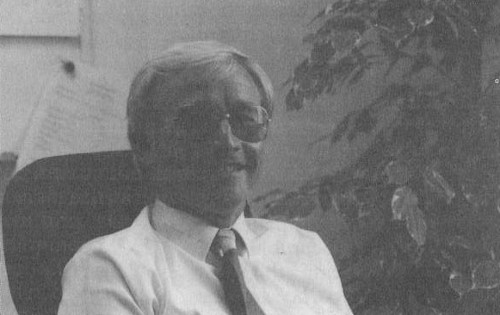
PAUL CANNEAUX
"Basically I’m an amenity horticulturalist, trained to look after
trees, shrubs, flowers, etc. in public parks. I worked for
Lewisham and then the GLC.
When the GLC was abolished most of the parks went to the
boroughs but the Heath was transferred
to the London Residuary Body and
finally the City of London was given the
responsibility of its ongoing management. I think it has ended up in the right
place; that’s a personal view. Obviously
the GLC, if it was still around, could
have gone on running it quite satisfactorily, but given the situation I think the
City will do a good job.
My role is to keep the City fully
informed about what is going on
although I have a relative degree of
autonomy.
As part of the discussion as to who was going to take over the Heath, the Government set up a trust fund of some £15 million but the interest from that, was never going to be enough, so, as part of the deal the City agreed to fund it additionally from its own resources by over £1 million a year. In addition a lump sum of £4 million was negotiated from the LRB to continue the capital work for long term projects like the cleaning out of the ponds. This amount...
...will need to be subsidised by the City to
fund additional projects.
The Lido, for example, will need
urgent consideration and whilst the City
has undertaken not to change anything
about it for five years, they will be
carefully reviewing its requirements. My
guess, a personal view, is that they will
look at the site and decide to keep some
sort of swimming facility there, and they
may wish to take the view that they will
have additional facilities, so you might
find things like weight training rooms,
saunas, that kind of thing. It’s a vast site
and there is a lot of space there that
might be better used than it currently is,
and coming back to your side of things,
there’s changing room accommodation
which is apparently used for cross-
country and that sort of thing.
We service two committees; the Management Committee and the Consultative Committee. The Consultative Committee consults with all interested parties. It comprises people like the Sports and Recreation Council and various other lobbies that have an input into...
Page 10
Paul Canneaux contined...
the Heath, like local amenity societies. Those that are not on the committee itself are in regular correspondence with us.
The Heath is an Open Space but in terms of usage it is a collection of just about every kind of recreational pastime you wish to think of, and provided it’s within the bylaws we try to cater for as many of these as we possibly can. At the moment, I think, our current list is about twenty “sporting” activities, and of course there is the ecology that we try to maintain as best we can, and inevitably there are conflicts, in fact that is what the job’s all about.
My line is to take a very thin balancing line between one man’s recreation and another man’s anathema. We get letters here even about jogging, why don’t we ban it.
The difficulty of the conflict depends on the strength of the lobby. Over the years at the GLC I can clearly remember a big hoo-hah about cross-country runners and the ecological interests. I’m very keen on ecology and when there is a conflict I have to weigh both sides very carefully, but at the end of the day, when a decision has to be made I would come down on the side of the ecological consideration. Having said that people then may think “Ah, he’s going to stop the cross-country runners”. No, he’s not going to stop the cross-country runners, because I have no intention of stopping what I see as a perfectly valid recreational pastime, provided it does not do any ecological damage to the Heath. It doesn’t concern me in the slightest that there might be patches they are running through and churning up. So what; it can get just as bad if you get a party of walkers or fun runs. You've got to be realistic and I don’t think the ecological effects of cross-country runs are necessarily a bad thing.
We do take care, as Eric Robinson will vouch, that the route does not go through environmentally sensitive areas, eg the sphagnum bog at Kenwood as that is protected by statute.
The National Championships? Lovely, why not? Let’s have it. The problem being the accommodation for changing, which is less than satisfactory, but hopefully in the future, with the possible Lido redevelopment things could get a lot better and I like the idea.
The Track. These things don’t last for ever and they don’t have anything like the life that manufacturers have claimed in the past. I think the City would be committed to maintaining it as a facility for the public. It’s there, it’s a well established thing, there’s a clear need for it and it’s got an established and well known athletics club based there. So it has got everything to say we should repair it and replace it when the need arises, so from my position I see no problem at all.
As far as developing the facilities; there has been a lot of talk with the consultant that’s been around and I know the LRB had a few ideas in mind. As an idea I don’t hold anything against that, but what we have to bear in mind is that there are two main constraints. One is local residents, their views, because it is quite close to houses nearby. Also the visual affect of any development has to be considered, and by the Heath Act we can only build to a maximum of twenty feet high anywhere on the Heath. Wha- tever happens it’s not going to happen in the next two or three years.
Everything is subject to consultation and, ultimately the members’ decision on the Management Committee. Personally speaking, I feel that something like that needs to be pushed along a little bit.”
Rob Bush
Page 11
CLUB RECORDS
Set Summer 1989
MEN - Senior
100m: Alex Fugallo 10.5
200m :Alex Fugallo 21.2
1500m :Ian Manners 3:42.6
10,000m :Eric Southam 29:19.2
400m Hurdles :Tony Willis 54.0
Hammer: Mike Reiss 43.66
Decathalon: Andrew Lewis 6528 pts.
MEN - Junior
100m :Alex Fugallo 10.5
200m :Alex Fugallo 21.2
Hammer :Charlie Cross 36.80
MEN - Youth
Hammer :Charlie Cross 49.28
Pole Vault :Bree Coutts 3.10
MEN - Boys
400m :Peter McGovern 54.0
80m Hurdles: Peter McGovern 13.4
Triple Jump :Peter McGovern 12.77
4x 400m : Lyndon Hammond,
Peter McGovern, Jamie Sorano,
Damian Smart. 3:50.6
WOMEN - Senior
400m Hurdles: Cathy White 64.1
WOMEN - Girls
800m :Youki Bevis 2:20.2
1500m :Youki Bevis 4:42.2
The De Savigny Second Century Award for 1989 was awarded to Eric Young. This accolade is awarded to the person who has done the most for distance running in the club in the year. The Distance Group had no hesitation in selecting Eric for the honour in recognition of his patient efforts to keep the Sunday Run organised for the benefit of all standards and his work on computerising the results of the Fun Run.
Peggy Shaeffer, who has now sadly left the UK, gave a fascinating talk to the Distance Group on Resuscitation of heart attack victims. Her lecture was illustrated by the use of a model and although only a small number of members attended the talk everyone was interested enough to ask questions and try their skill on the model. We feel that there is always the possibility of a runner being in the position of having to deal with a heart attack victim and we would encourage members to brief themselves on what action to take. We give opposite the basic steps as recommended by the British Heart Foundation but would stress that a proper demonstration is really essential.
We apologise for stating in the last issue that Mike Reiss’s new Hammer Record beat that set in the 1960s. It was in fact set by Paul Deeks in 1986.
Coaching: Both Ian Adcocks and Stuart Brunton have now taken their Assistant Club Coach awards and are coaching club members. We would point out that this qualification offers a good introduction to track and field techniques and a broad outline of general coaching theory and would advise any prospective coaches that the next series of courses starts very shortly. Anyone interested should see Ian, Stuart or John Wild.
Page 12
WHAT TO DO FOR SOMEONE WHO HAS A HEART ATTACK
To help someone who is unconscious following a heart attack call
an ambulance and proceed as follows:-
Tilt the head back and clear the airway
Give mouth to mouth resuscitation
Close nostrils with fingers and blow
into mouth. If chest does not
expand, make sure head is tilted
fully back and lift jaw upwards and
forwards. Make sure there is no air
leak at the mouth.
Check that pulse can be felt in
neck. If not Compress chest for
circulation
Place both hands on the lowest
third of breastbone which should
move 1.5 to 2 inches. Alternate 2
inflations with 15 compressions and
perform 4 cycles in each minute.
(Source - British Heart Foundation card.)
NB. Peggy Shaeffer explained that
the above procedure is not designed to restore the patient to consciousness
(although it may do so)
but to keep him or her alive until
professional help arrives. Accordingly, if you are alone with the
patient you may have to continue
for some time until someone else
comes so one of you can go for
help.
THE BATON CHANGE
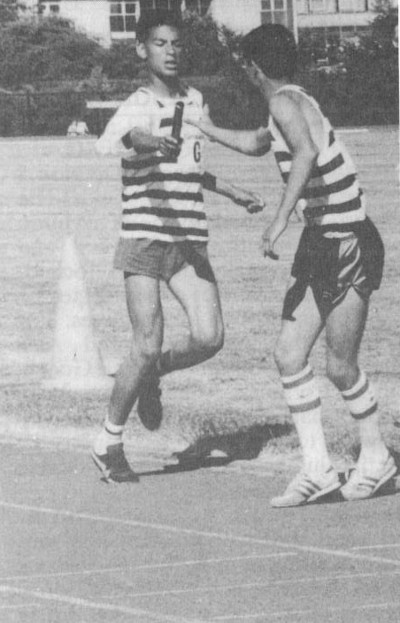
"Well run. you were looking good"
"Thanks, it was a bit windy on the back
straight but I didn’t feel too bad. Good
luck on your leg, by the way"
"Thanks very much. Well I'd better be off
"O.K. see you later. Oh you’d better
take the baton."
"Right, cheers! See
you then"
The Regents Park 10km races will resume under, temporary we hope, new management on 1st October and on the first Sunday of each month up to March (and maybe April).
Page 13
THE RECOUNT
PAUL HOLLAND reports on our Division One match at Parliament Hill which had an unexpected sequel...
Our fourth Southern League Division I fixture was at Parliament Hall Fields. The opposition was made up of Milton Keynes, Portsmouth, Shaftesbury and Chelmsford. Normally not too formidable but this year we continue to be troubled by injuries to key athletes. For this match the injury list read Alex Fugallo, Okan Gulutu, Mike Gooch, Adrian McCormack, Mike Quinn, Mike Reiss and half of Andrew Lewis, who didn’t want to aggravate a leg injury by doing the jumps - quite a formidable team on their own.
The 400m Hurdles gave us our accustomed good start with Tony Willis winning the A string in 56.2 and Ian Adcock the B in 59.4. The good half of Andrew Lewis was picking up points with 3rd in the 100m (11.1), 3rd in the Shot (12.56) and 4th in the Javelin (43.26).
Our reservists from the B team Pete Ilo (100m - 4th 11.9, 200m - 3rd 24.1, Long Jump - 3rd 6.14 and Triple Jump 4th 12.88), Paul McKeever (400m - 3rd 51.8) and Dan Maxwell (400m B - 3rd 52.7) were certainly not overawed by their promotion and demonstrated what has saved us this year - our continued development of good performers in the B team.
The 800m and 1500m continued to be good points earners with Ian Manners and David Hoinville winning both A and B strings in the two events (1:56.3/3:53.3 and 1:56.8/3:54.3 respectively).
The 5000m saw Paul Naisbitt’s debut for the A team and he didn’t disappoint with a 14:58.5 third place behind the winner, Mike Williams of Shaftesbury. Steve Blaney finished 2nd in the B string with 15:13.1
In the field Gerry Cassells improved his season’s Long Jump best with 6.42 which gave him 3rd place and he came 2nd in the B string Triple Jump with 12.50. Nigel Woolgar again won the High Jump at 1.90.
It was only as the programme drew to a close that the drama began. With only the 3000m steeplechase, the relays and the discus to go just 14 points separated the first four teams. Milton Keynes 101, Shaftesbury 98, Highgate 95, Chelmsford 87, Portsmouth 64.
In the sprint relay Alex Fugallo agreed to give his injured leg a try out and managed to anchor the team to first place without stretching too much. There were now only 3 points covering the first 3 places. Milton Keynes 103, Shaftesbury 102, Highgate 100.
In the Steeplechase we again saw the extraordinary progess of Dave Burrows whose 9:31.8 for first B string placed him close behind Mark Chapman’s 9:27.9 for the 3rd A string a A good class race with 7 runners under 10 minutes.
Continued ....
Page 14
The Recount contined...
With the 4 x 400 and the Discus to go Highgate were just 1 point behind Milton Keynes and 4 in front of Shaftesbury. The 4 x 400 made things even closer with our 3rd place brining us level with Milton Keynes and Shaftesbury just 3 points behind. But without Mike Reiss in the discus and Andrew Lewis pretty tired we surely couldn’t do it. But behold! a mysterious figure, looking like Mike Reiss appears from the grass verge, discarding crutches and followed by a nurse and proceeds to lob out the discus. However, even with his valiant effort we only managed 4 points to 10 for Milton Keynes and 8 for Shaftesbury.
The “final” result was Milton Keynes 120, Shaftesbury 119, Highgate 115, Chelmsford 105, Portsmouth 77.
Well Milton Keynes went away winners, but to prove that the match doesn’t always end on the track, after checking the results we found that the 200m B had been wrongly recorded as a win for Milton Keynes instead of Chelmsford. Therefore Shaftesbury had won by 3 points with Milton Keynes just one point ahead of Highgate. I spent several hours on a summer evening trying in vain to find that one point. Well, we got our money’s worth.
The season finished with the A team 9th in Division One and the B team 17th in Division Four. With our keen rivals London Irish and GEC promoted to the National League we surely have our best chance next year to secure our own National League place.

Page 15
BUSY B TEAM
The “B” team may seem a bit of an anomaly in a club whose officialdom is stretched, sometimes beyond its limits, in organising its men’s Southern League “A” team. In fact it is the very existence of the “B” team that has enabled our “A” team to scale the dizzy heights of Division One. Even in a season such as this when we have been hit by more injuries than the England cricket team, the “A” team has been adequately reinforced by reserves plucked from the “B” team where they were gaining match experience and where their form was well known to the team managers.
The team has been comfortably residing in Division Four and finished the season in 17th place - well clear of relegation and even further away from promotion. A typical match was their last one at Walthamstow (well, not absolutely typical as we actually won it) and we would like to report it in full detail. Unfortunately the full detail seems to have been misfiled so we can bring you instead one of the editor’s impressions of the event.
A great help was the fact that Charlie Cross and Joe Phelan had been allowed by John Wild, their coach, to throw senior implements in the Hammer, Discus and shot for the first time. In their main event, the Hammer, Charlie was second A and Joe first B, which was pretty good for Youths. Charlie also substituted for your injured editor in the High Jump where he beat no one at all.
As everyone in the B team does lots of events this is no longer remarked on by regulars but Pete Ilo (returned from the previous A team match) did particularly well to win both Long and Triple Jumps and run both relays - we won the 4x 400.
Martin Hughes, who has been going some time now, was delighted to achieve two personal bests, in the 400 hurdles and 110 hurdles ably abetted by former young athlete (aren’t we all?) Dominic Hall who had never attempted the high hurdles before then.
Eamon Duckworth had an unusual problem in the 400m - his hat nearly fell off which rather affected his style. In the relay he ran without it to much better effect which is partly why we won it. Another schoolboy, 18 year old Alex Pascall (recorded in the official results as “A.Pascoe” - if only it was!) showed great hope for the future in the sprints.
Richard Priestly, not another schoolboy, teamed up with Dominic Hall to score a double win in the 800m races and in the 5000s road runner Steve Blaney also stepped down from the “A” team to partner Albert Prendiville with a 2nd/1st result.
Your editor was, as mentioned, injured and had to content himself with doing only the Pole Vault in which he managed a distinguished 3 metres to come 2nd. (This is the only actual result he can remember in detail). Ian Reynolds was 2nd in the B string (we would be able to give you this result in detail as well but it may well be actionable to do so).
At the end of the afternoon we found we had won, for the first time this year. Exactly who the other teams were is not important, and we can’t remember anyway. We also apologise to those team members who haven’t been mentioned but their names are all on the missing results sheet.
Written by Bob Slowe from original ramblings by Rob Kennan.
Page 16
THE SLOW GROUP
Marian Campbell reports on an important but often neglected section of the club
At 9.00 on Sundays there is a large assembly of runners outside the track. Sharp at nine about two thirds of the group takes off running very quickly, they are known as the “fast group”. A few minutes later you will see the remainder, anything from 5 to 12 in number, take off at a much more relaxed easy pace; some will look sleepy and tired, others will be chatting away. This group was known as the “women’s group” but as there are several men it is generally now called the “slow group”
Sarah Cawkwell originally formed the group to encourage women to run with the club. Gradually we became a mixed bunch but no matter how slowly you run there will always be someone with you, no matter what distance you want to do.
We have in the slow group quite a number of faster runners who for many reasons enjoy running with us. Take for instance Anne Hearn who this year did the London Marathon in 3 hrs and 46 seconds and was second in her age group. She is a great inspiration to us all, running with those of us who run around 4 hours. We puff and pant while Anne chats and take our minds off the pain. Anne runs with us because she enjoys the friendship which abounds within the group. Running with people faster than you can be pressurising but it has many advantages and many of us who have achieved PBs owe them to people like Norman Slater, John Jameson, Margaret Clinton, Charles Allen, Sarah and others who were there on Sunday mornings and through the dark winter evenings to encourage and push us on.
There are Claire and Stephanie. Claire started running last October and I distinctly remember how hard she found the 3 mile lap of the Heath. She was accepted for the London and came out with us Tuesdays, Thursdays and Sundays and finally ran the London in 4hrs 5 mins. Stephanie had run with the group before but only on Sunday mornings and had never done any long distances. She also got accepted for the London and was worried about her ability to do it. However, she stuck to it and on the day she and I ran together for 13 miles. She went on to do 4hrs 20mins and was absolutely thrilled.
Then there are the two Erics, Robinson and Young. Both of them have the
good of the club and the distance
runners at heart . Eric Robinson helps
us through the bad times with his kind
words of encouragement and when it
really hurts and you just want to lie
down, a little hug works miracles!
Peggy Saaeiee was another member
of the group. She has now returned to
America. Peggy advised us on our in-
juries and general health and was such a
lovely outgoing cheerful individual. She
had a great morale boosting affect. She
ran a PB too in the London. 3hrs
30mins.
Doing PBs is as important to slower
rumners as it is to the elite and for me,
doing a PB this year was my “Gold”.
Everyone can be a winner.
If this has tempted you to join us, please come along - you will be warmly welcomed. You will find us at the track about 6.30 pm on Tuesdays and Thurs- days and of course 9.00 am on Sundays.
Page 17
THE FEW
Mike Quinn reviews the Ladies season
After the usual bright start numbers dwindled, due to injuries, leaving the trusty few to soldier on filling in all sorts of events. However, we have persevered and performances by the girls were always spirited with many personal bests and not a few club records. Versatility was certainly the name of the game as Marnee Quinn, normally starring in the middle distance recording personal bests in javelin and discus. The author is going to have to watch his step with such power developing!. But prize for star all-rounder must go to Cathy White. She would do well as a pentathlete. Highlight was the decimation of the club 400m hurdles record; this after Jack had told her to jog round - half way down the home straight he had definitely changed his tune.
Cathy also set personal best times for 800m recording 2:11.8 in a stirring race in which she was just pipped by international Anna Wittckind. In between she scored much needed points in the 100, 200, long jump and both relays.
Another revelation this season has been Karen Chitty, once competition shy but who now can’t get enough. She has increased in confidence with every meeting setting very respectable times over 100, 200, 400 and 400 hurdles, and she has the potential to go much quicker, given a good winter’s training.
Sarah Andrews made the difficult transition from Junior to Senior without any problems. She improved her 800m time to 2:20.2 and was close to the intermediate 400m hurdles record, giving us an embarrassment of riches in this event.
Other reliable points scorers were
Juliet Kavanagh and Hileen Hodnett.
At least the author will not have to
wear sun glasses next season to ward off
the glare of Di Krzyzanowska in her
multi coloured tights. We wish her well
in the future and it was good to see her
throw her best javelin for three years at
Portsmouth in her last season with us.
A special mention must be made of Lisa Webb, who, though not very fit, or well, still turned out in most matches to do the 800 and 1500.
Star of the junior squad was again
Youki Bevis who destroyed all middle
distance opposition. Her determined
front running was a joy to watch. She
won the Middlesex junior 800 and 1500
and also took the Southern Inter-Counties 1500 title. She also set two club
records.
Anya Smith is another budding pen-
tathlete. She won the London Schools
pentathlon. She has a good turn of speed
in the sprints, endurance in the middle
distance events and strength for the
throws and jumps. Unfortunately a foot
injury prevented her from running for
part of the season.
Youki and Anya were well backed up
by Helen Yaffe, a promising new middle
distance runner, Kris Monaghan, Natalie
Duck and Kimono Fowler.
Even though 20th in the league is a disappointing result the “few” performed with great spirit. My favourite memory was undoubtedly the battle of the middle distance heavyweights at Aylesbury. There Youki defeated the thorn in her side Joanne Mitchell (Southern 1500 champion) in a thrilling race. It had supporters from both clubs screaming from the sidelines.
Thanks must go to the backup people. Rob Kennan patiently drove the minibus while Eddie Randolph and Jim Evans performed on the timekeepers’ stand and, of course, Jack.
Page 18
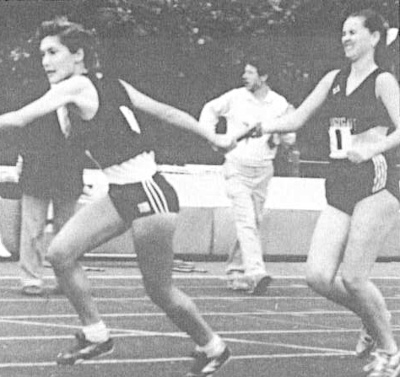
Cathy White and Marnee Quinn
Murphy once again generously sponsored the Open Meetings which
culminated with the major event on 3rd September when the Murphy Mile was held.
This was won by international Billy Dee
with Ian Manners in second place.
The
much awaited Tug of War team from
Murphy failed to materialise. It is
rumoured that they were still in the pub
warming up. However, a team from the
Met Police made short work of Highgate
by pulling them over three times out of
three.
Thanks to Martin Holland for
organising the Open Meetings.
Further to our piece in the last issue about the Heath Steering Committee, we had a helpful reply from John Wixley and hopefully we will in due course be represented on the committee.
Next year’s Southern League Dates
5th May
26th May
23rd June
7th July
21st July
11th August
PLEASE KEEP THEM FREE
WE WIN THE ST ALBANS RELAY
For the first time Highgate lifted the
St Albans relay trophy. This prestigous 6
x 2.5 miles cross country relay has always
been a favourite with club members but
despite many 2nds and 3rds we had
never actually won it. However on Saturday 16th September we finally did.
Andy Crane put us in first place on leg
one and Shane Snow kept us 30 seconds
clear. Chris Bailey on leg three dropped
a little and handed over with a 20
seconds deficit to David Hoinville. He
regained the lead and gave Mark Chapman a margin of some 30 seconds. Mark
held on to give Ian Manners a start of
some 5 seconds over Luton. Luton were
soon up with Ian but over the latter
stages he ran away to win by some 40
seconds.
NEW MEMBERS
We are glad to welcome the following new members who have joined the club since the last issue of the Gate. We hope you will all be with us for a long time and we wish you every success with the club.Paul Gorney
John O’Dornell
Waldo Barker
James Morton
Ben Winter
Dan Maxwell
Andrew Crane
Natalie Duck
Fiona Williamson
Ciaran McCrossan
Nicholas Joannou
EVEN NEWER MEMBERS
News has reached us of the birth of a son for Jeremy Stratton and another for Jane Spence. Congratulations all roundPage 19
HIGHGATE
HARRIERS
Training Venue
Parliament Hill Fields Athletic Track
Training Times
Tuesdays and Thursdays 5.00pm onwards
Sundays 9.00 am (Distance Runners)
10:30 am onwards (others)
President: Eric Robinson
Treasurer: Alan Corfield
Secretary: John Wild
Membership: Martin Holland
Information From:
Terry Driscoll (Men's Athletics)Lisa Webb (Women's Athletics)
John Jenkins (Road Running)
Rob Kennan (Young Athletes)
John Powell (Race Walking)

Page 20